
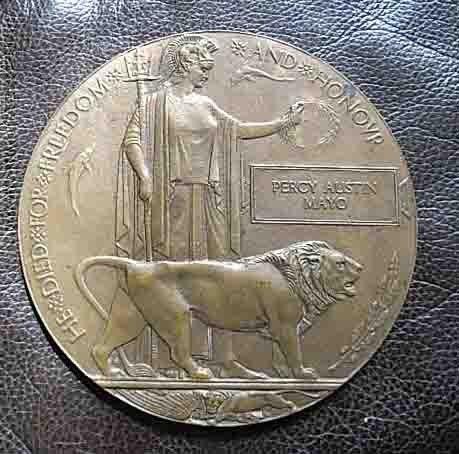
Percy Austin Mayo was born on 14 December 1884 in Piddlehinton, Dorset, his father, Charles, was 35 and his mother, Emily, was 30. Percy was the youngest of 6 children, he had two brothers and three sisters.
In 1891 aged 6 Percy was living in Piddlehinton where his father aged 41 is listed as a retired farmer.
His father Charles passed away on 22 January 1893, at the age of 43.
In 1901 aged 16 he was a boarder at Milton Abbas Grammar School (MAGS) alongside Edward de Quincy Mears then aged 8 and Dennis Claude Grant St Ledger (10) who would also eventually appear on the MAGS war memorial alongside Percy.
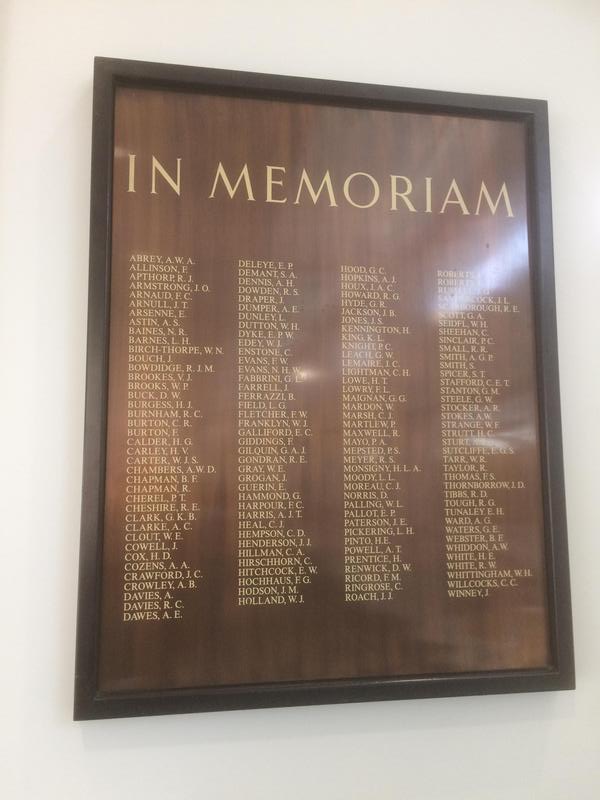
By 1911, his widowed mother was living in Spa Road Radipole on the outskirts of Weymouth and Percy the only remaining child still at home is listed as a Bank Clerk. This was a popular career choice for Old Miltonians – Stanley Fenton Smith and Harry Horace Boyne (nee Bugg) had also joined banks. As Percy eventually appeared on the Thomas Cook memorial and that he is referenced in the proceedings of the Society of Dorset Men in London it may be surmised that he moved on from Weymouth before the outbreak of war.
Looking then at his officer records held in the National Archives he still puts his occupation as Bank Cashier and his permanent address as 94 Spa Road, Radipole. He enlisted in the 3rd Bn Dorset Regiment on 31 August 1915 and was confirmed as a candidate for a commission in the Special Reserve on the 4th September. He began training at Wyke Regis camp immediately after. The third battalion was a training organisation intended to provide drafts of reinforcements for France.
As the history of the Dorset Regiment puts it: “…before the close of 1915 there were over one hundred officers belonging to the regiment stationed at Wyke, and within the first two years of the War, more than three hundred officers and six thousand other ranks were despatched as reinforcements to the front…”
Percy then seems to have undertaken a standard infantry officers’ course of instruction until May 1916.
His officer file in the National Archives goes straight on from his enlistment and medical records straight into an ‘extract from letters of administration’ noting that Percy had died intestate without father on the 9th of May. So what happened?
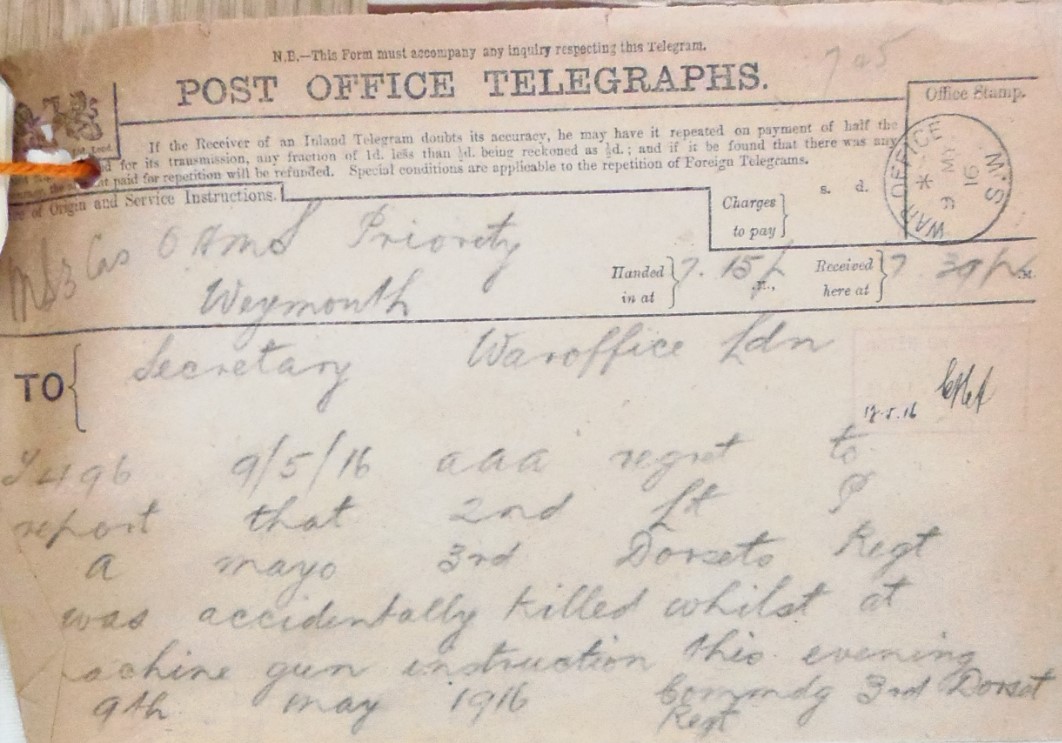
The next page is a letter between staff officers which, to modern eyes, refers to a situation which almost beggars belief.
The attached expert opinion is forwarded for your information. It has been noted that you have forbidden the use of live cartridges in future. Please also impress on all concerned that it does NOT say in the handbook that a LIVE cartridge is to be used in stripping the gun and that consequently they were grossly in error in using one.
No doubt something can be devised to take the place of the “bullet” mentioned in the handbook. At any rate this has now been done at Hayling Island*, according to the last two paragraphs of the attached letter.
Please return all correspondence.
* Southern Command School of Musketry, Hayling Island
The attached letter referred to a practice of using a round to assist in stripping the weapon. “When teaching ‘stripping’ we always make a point of using a round from which that charge has been removed; this is in my opinion absolutely essential, and, since hearing the account of this accident, even these dummies have been forbidden.
On no account should a live round of any description have been used in illustrating the action of the ‘feed arm’.
Headquarters,
Southern Command
I personally investigated this regrettable occurrence. It was of course most improper to use a cartridge that had misfired, although rendered unable to be pushed home into the barrel, for the demonstration. The Instructors appear to have been under the impression that such a cartridge was safe and could be used for the purpose, because the handbook says that a live cartridge can be used in stripping the gun. Orders have been given that no cartridge with a charge in it is to be used in future.
Weymouth 19 5 16
A Court of Inquiry was convened the next day at Wyke Regis Camp:
1st witness Lt GR King states.
I am Machine Gun Officer to 3rd Dorset Regiment, at 5 pm on 9 -5-16, the new classes for officers in machine-gun began. During the first hour. I supervised and listened to the instruction given by my instructors. About 6 pm a break was given of 10 minutes. About 6.10 I gave the order to continue, watched the instructors for a few minutes and then went to the table where I do my writing and studied some pamphlets from the Orderly Room with reference to Maxim and Lewis guns. I hadn’t been there two minutes when I heard an explosion. I rushed to the nearest gun which was the Lewis and my glance fell on an officer in the Maxim class who was being attended to by another officer also under instruction and Sergeant Bullard the instructor. I knew at once someone was hit and immediately sent for the doctor, and myself went down to the orderly room and reported to the Adjutant that an accident had occurred. On my return with the Adjutant, I discovered that it was 2Lt P A Mayo who had met with the accident. I immediately went to the Lewis Gun and found the cocking handle in the number two position. I pointed this out to the Adjutant and I tried to pull back the cocking handle but did not succeed the first time. I gave it a second and harder wrench and this extracted the empty case. I examined the empty case and found that it was a damaged cartridge used purely for stripping the gun. It was originally a cartridge which had misfired, damaged for safety’s sake, and in my opinion, the instructor was in no way to blame for using it. The position of the cocking handle indicated at once that the striker had not gone forward far enough to strike the base of the cartridge. The explosion may therefore have been due to some other cause. Signed G R King Lieutenant.
Second witness, Sergeant Shonfield states:
I am Machine Gun Instructor to 3rd Dorset Regiment. On the 9th of May 1916 I was instructing a class of officers in the Lewis Gun. I was giving the action of the feed-arm and showing the workings of the cartridge guide spring. In this purpose a dummy cartridge is of no use, as the weight of the bullet is required to make the base of the cartridge come up, I used my thumb as the cartridge guide spring and pushed forward the piston rod and bolt; this forced the round further into the breach and the explosion took place. I used a cartridge which had been deliberately damaged to prevent it from going right home into the breach. By the construction of the gun, it is impossible, unless the cartridge is forced right home, for the striker to touch the cap of the cartridge. In addition to this, the cartridge used had previously misfired. In my opinion, the cartridge was perfectly safe and I cannot in any way explain the cause of the explosion
(signed) W. Shonfield Sergt.
Third witness No 12251 Private A English states:
I am Storeman for the Machine Gun Section 3rd Dorset regiment. On the 9th May 1916 at 5pm I was asked for a round by Lt King for stripping purposes for which I always keep two bullets. An armourer’s dummy and a misfire also damaged. I produced the one that was damaged both being considered safe according to the official handbook on the Lewis Gun (1915).
(signed) Private A English
https://www.cwgc.org/find-records/find-war-dead/casualty-details/286278/a-r-english/
Fourth witness. 2 Lieut H W Borrough states:
On the evening of 9 May 1916 between 5 and 7, I was in attendance at an officers’ class of instruction in (the) machine gun hut. Sergeant Shonfield was instructing. At 6.10 we had 10 minutes break, at 6:20 we recommenced, the sergeant was illustrating the action of the feed-arm using for the purpose a round with a bullet in it, which had previously been used for stripping and was damaged and a misfire. As the bullet slipped from the slot into the body there was an explosion. I looked up and thought at first, no one had been hit but then saw 2Lt Mayo slipping to the floor. I went to him and told those supporting him to put a hand on the injury sent for the doctor and the medical orderly. When the doctor arrived at 6.40 2Lt Mayo was dead.
(signed) Horace W Borrough 2Lt
https://www.cwgc.org/find-records/find-war-dead/casualty-details/170393/horace-william-borrough/
Later the same day the Coroner convened an Inquest. This is a transcription of the report published later that week.
Southern Times Saturday 13th May 1916
Dorset Officer’s Tragic Death
Live Cartridge in Machine Gun
Another Officer’s Narrow Escape
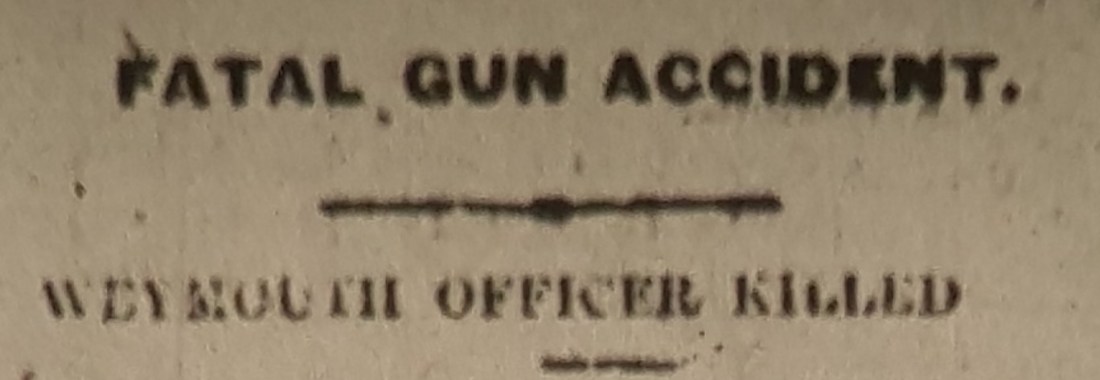
Mr GP Symes (Coroner for South Dorset) held an inquest at the Guildhall and at the Dorset camp, Wyke Regis, on Wednesday afternoon, into the distressing and tragic circumstances attending the death of Second Lieutenant Percy Austin Mayo, who, while listening to a lecture in one of the huts, was stuck by a bullet of a live cartridge from a machine gun upon which some officers were being instructed at the other end of the room and killed instantly.
Mr Alex Pengilly appeared on behalf of Messrs Andrews Son and Huxtable to represent the family. Mr A Whaley was chosen foreman of the jury. Supt Sprackling and Supt Day were also present.
The coroner said this was a very tragic matter which they were called to inquire into, the information given to him was that at an officers’ lecture on Tuesday afternoon there were two classes going on in the same hut. One was being instructed in a machine gun and the others were hearing another lecture at the other end of the hut. By some means or other a live cartridge got in to the machine gun and it exploded, killing an officer who was sitting at the other end of the hut listening to the other lecture, having his back to the gun. The bullet struck him at the back of the head and killed him instantly. Another officer had a narrow escape, the bullet cutting his cheek open.
After viewing the body in the mortuary, the jury were conveyed to eth Dorset camp, where the rest of the inquiry was conducted in the reading room. Colonel E C Castleman Smith CB the commanding officer and other officers were present.
The coroner expressed extreme regret at the loss of this young officer who was a member of a well-known Dorset family, which had been associated with the county of Dorset as long as he could remember, and, he was sure, as long as Colonel Castleman Smith could remember. He knew his father very well.
The jury the inspected the hut were the accident occurred, the machine gun officer pointing out the position of the gun and where the deceased was sitting at the other end of the room. Mt John Brown, brother in law of the deceased gave formal evidence of identification. Deceased was 30 years of age and unmarried.
Sergeant Walter Shonfield said that on Tuesday afternoon he was engaged instructing a class of officers in the mechanism of a Lewis machine gun. For the purpose he wanted a cartridge with a bullet, but minus the explosive part. These cartridges were kept by the storeman. He found one, which was put on the table for his use. He did not know whether it was live or not but he found it too damaged to go fully home into the chamber. He took off the cartridge guide springs to show how the cartridge was inserted and carried forward into the chamber. Witness put in the cartridge and pressed the base down wit this thumb and then pushed the piston rod forward to carry the cartridge into the body. As it dropped into the body it exploded immediately. The bullet first struck a magazine on the table and then another one and then it struck the deceased in the back of the head. Witness added that he had to force in the cartridge from the slot to the body. He knew there was a dint in the cap and that it was a mis-fire cartridge; but he did not know whether the explosive had been removed or not. He thought that the pushing of the cartridge by the bolt forward into the body was the caused of igniting the charge. If there had been any grit filling up the old dent it would be much more likely to ignite the charge. Mr Mayo was engaged in other class distinct from his at the other end of the room. In reply to Mr Byles (a member of the jury) witness said he thought the cartridge exploded before it got fully home.
Private Allan English said he was storeman for the Machine Gun Section and he gave Lieutenant King a cartridge for stripping purposes. This was a cartridge, which had been misfired and was also damaged. This cartridge has been in his possession for six weeks and had been given out for stripping purposes before; he had also the armourer’s dummy cartridge wit the explosive taken out, he knew one from the other.
Lt George Richard King said he was in charge of the instructional course in the machine gun. Shonfield’s evidence was correct. He stripped the gun and left the cartridge on the table. Knowing it was damaged he should have thought twice about using it himself but he did not know himself that Shonfield was using it for instructional purposes, and he certainly should have asked for one with the charge taken out, although he thought himself that the misfire cartridge was quite safe.
He considered that the explanation given by the sergeant as to the cause of the explosion was the only feasible one. He did not know whether this particular one had been used before for instructional purposes. Witness added that in the official handbook it was laid down that they might use a live round; but as a matter of fact they damaged it for safety’s sake.
The coroner: I think I should take the explosive out in future.
Dr Harvey said he was summoned to the Dorset camp and found the deceased officer on the floor of the machine gun hut, his heads supported by a brother officer and a sergeant. He was quite dead. There was an extensive wound at the back of the head, with considerable haemorrhage and scattering of brain matter. It was a lacerated wound such as one would expect to be caused by the distorted bullet, which had struck other objects first. Death would have been instantaneous.
The Coroner, summing up, said there was no doubt that the cause of death was the accidental discharge of the cartridge. It seemed unfortunate that it should have been imagined that the cartridge was quite safe. He took it that no cartridge was safe as long as it had got an explosive in it. But it seemed to be the practice to use them and they never thought there was any danger in it. The jury returned a verdict of “Accidental Death”
The foreman It is the view of the jury that these live cartridges should not be used
The coroner Otherwise you do not find any blame attaching to anyone in the case?
The foreman No they wish to comment the Sergeant on the evidence he had given, which was most satisfactory.
The Jury gave their fee to the Dorset Prisoners at War fund
The deceased officer was a son of the late Mr Charles Mayo of Piddlehinton, the well-known Dorset agriculturalist, and his mother lives at Radipole. With her and the deceased’s brother (Mr Harry Mayo) and his three sisters (Mrs John Rowe, Mrs Jennings, and Miss Ida Mayo) the deepest sympathy is felt
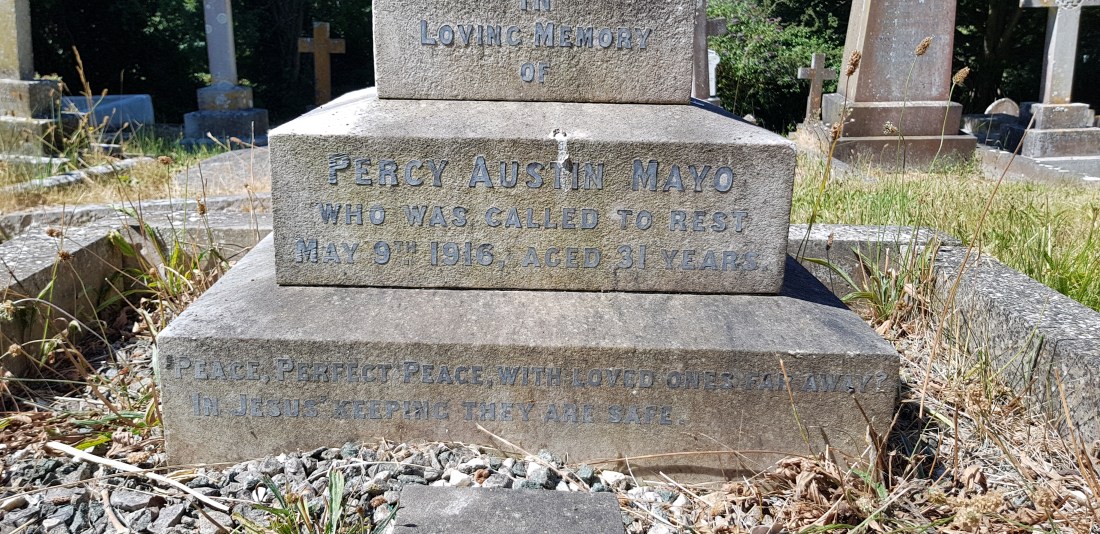
Percy’s grave in St Anns Radipole Churchyard Extension
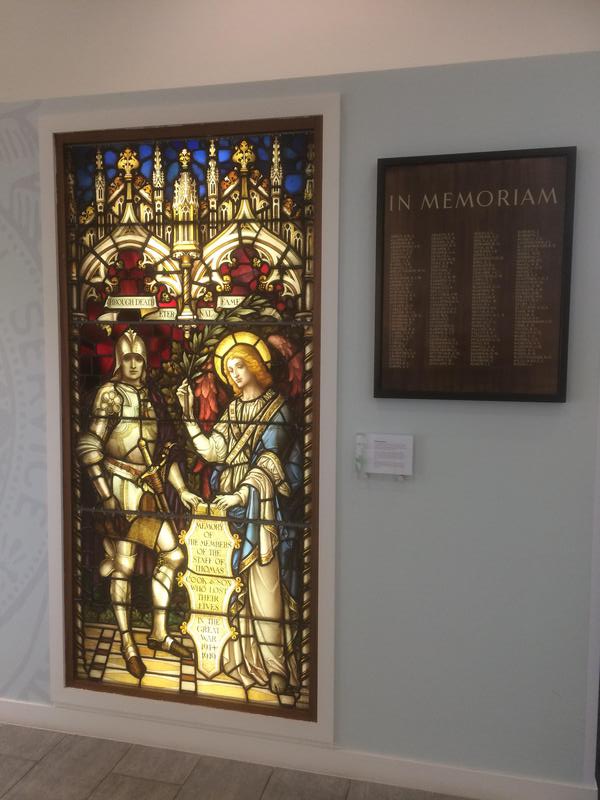
(Above and below) The Thomas Cook memorial and window


Weymouth War Memorial on the Seafront
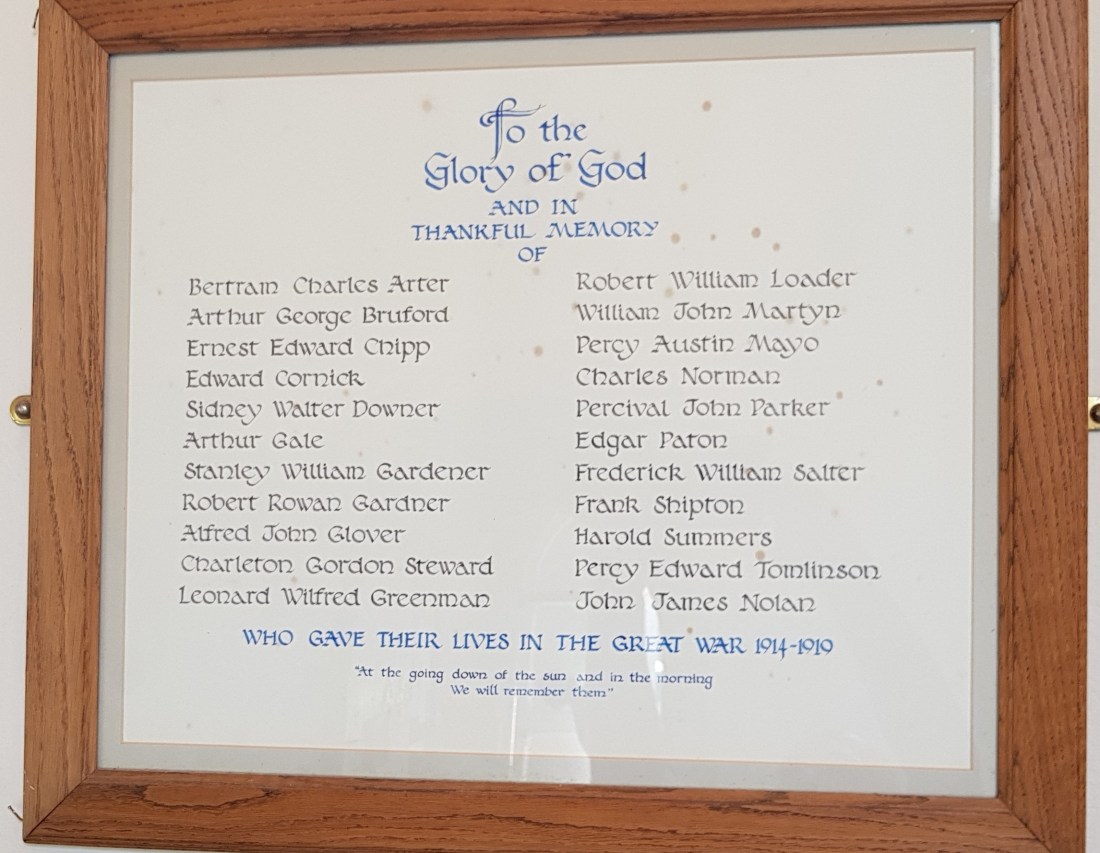
Inside St Anns, Radipole
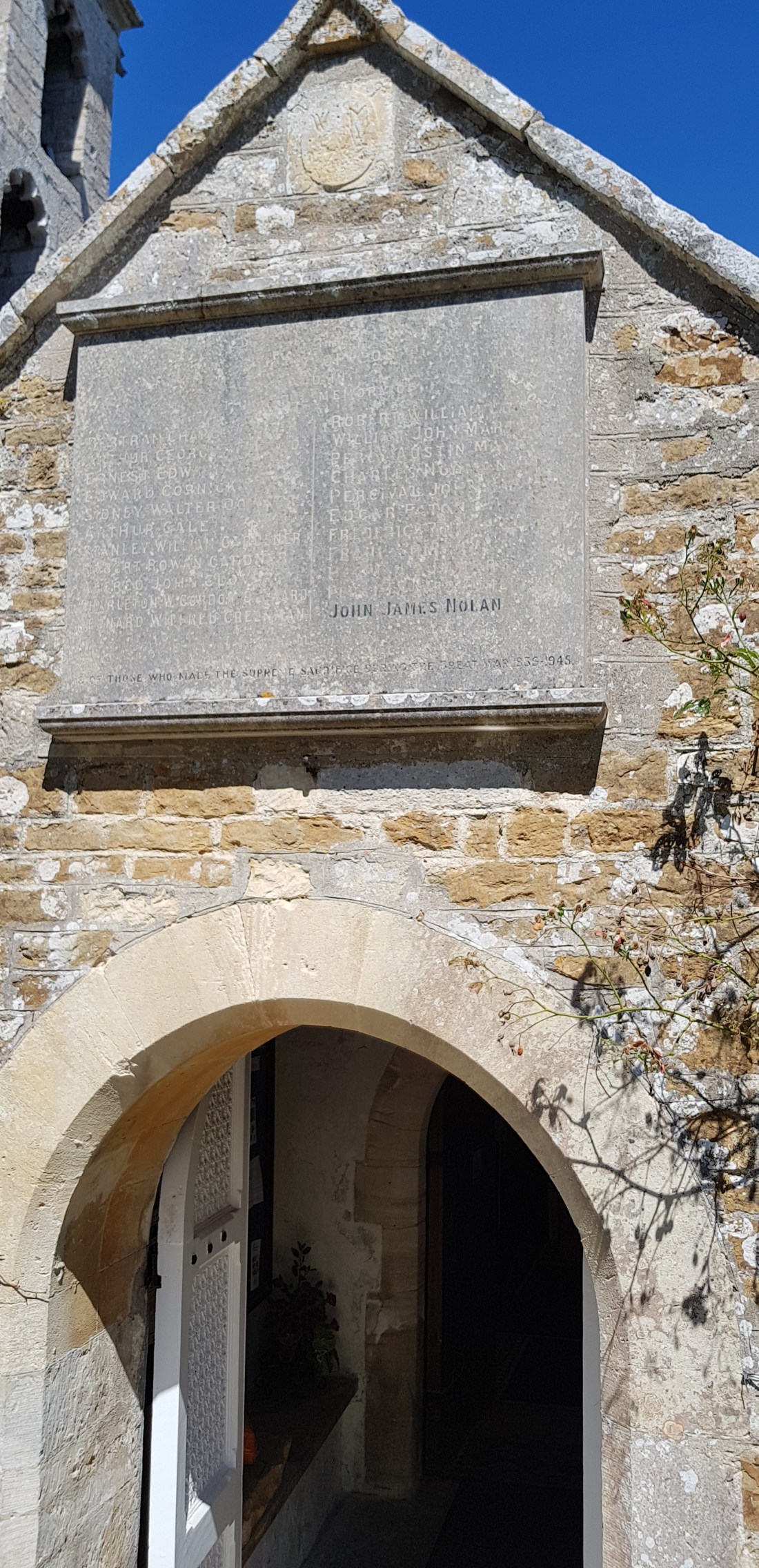
The doorway to St Anns, Radipole

The Society of Dorset Men in London Roll of Honour
 Blandford Schools' Combined War Memorials